A leap of faith leads to big impact for Alison Hoeman
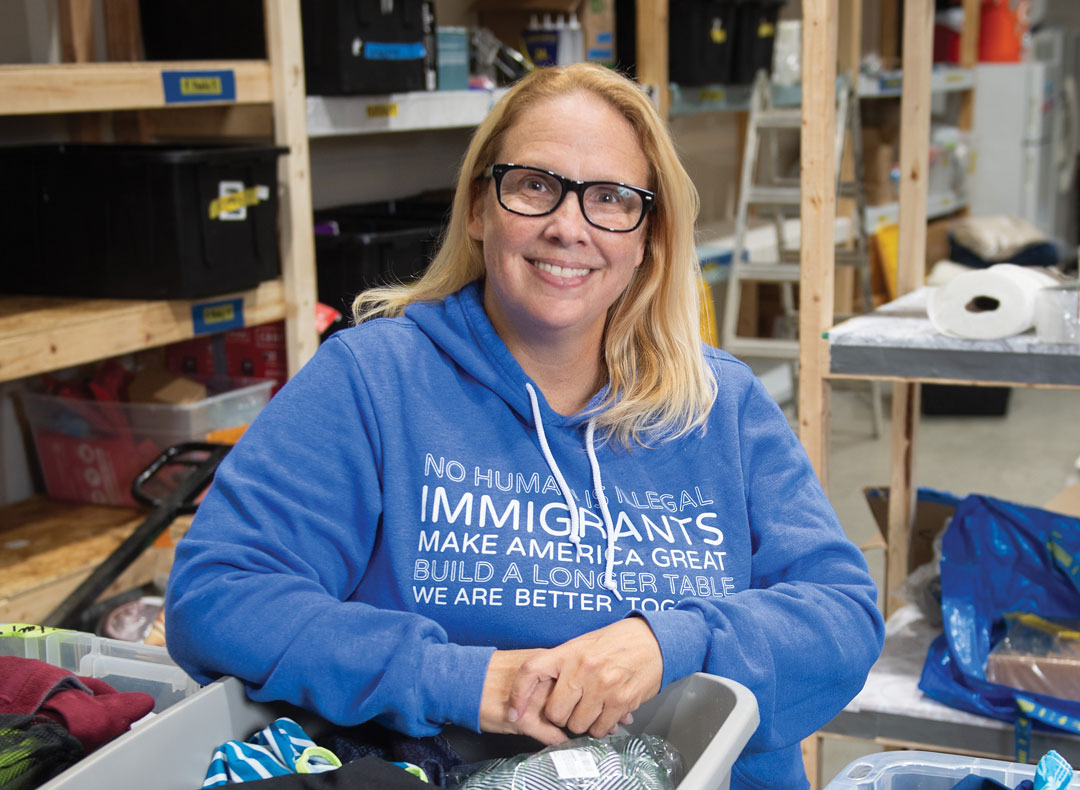
As told to Macey Shofroth | Photo by Duane Tinkey | Illustration by Kate Meyer
As an ELL teacher in the Des Moines Public School district in 2016, Alison Hoeman was preparing to welcome young refugee boys into her classroom. However, she learned the family would be moving to a new district just days after meeting them.
Hoeman asked the interpreter if the family needed anything. They said they needed everything. She gathered donations of essentials for the family, eventually accumulating enough for other families as well. Her nonprofit, Des Moines Refugee Support, was born.
DMRS has since expanded to support hundreds of refugee children and families. The organization helps enroll children in preschool, provides bus passes for students to get to school, collects donations to provide everyday essentials and provides scholarships for students to attend college. One of the organization’s fastest growing services is its soccer program, which helps children of all ages get involved in the sport by providing for the costs, transportation and food.
“The amount we’ve been able to grow is just unreal,” Hoeman said. “It’s unreal what we’ve been able to do.”
Hoeman sat down with Fearless to talk about the decision to leave her teaching job and become the full-time executive director of Des Moines Refugee Support.
The following story has been formatted to be entirely in her words, and has been edited and condensed for clarity.
I was a teacher for 22 years. I did a lot of things that a lot of people are like, “You did what?” I taught in Honduras, Colombia, Paraguay, Shanghai, Hawaii, Boston. I’ve been all over. I feel like a lot of people in Iowa don’t even have a passport, and they’re like, “You did what? You didn’t just visit there? You lived there?” I’m like, “I don’t know, whatever, I just did it.” I also lived in Spain and England.
But I think the scariest thing that I actually did was to quit my job and start this nonprofit. I first started this in 2016, and 2022 is when I decided that this would be my full–time job.
It was after COVID when all teachers were like, “Get me out of here! This is awful.” It was 2022, so it was a little bit past COVID, but it was still a disaster. There was someone named Dylan DeClerck who was the head of Opportunity on Deck, and they became Can Play. He started Opportunity on Deck when he was a sophomore in high school. He went to Valley High School. He was like, “Hey, Alison, I’m going to take you to lunch.” Then he was like, “Here’s what you’re going to do.”
I said, “I’m sorry, what?” He said, “Here’s what you’re going to do. This can be your full-time job.” He explained to me how we were going to do it, all the things. I had a 2-year old. I have a master’s degree and I had enough teaching experience that I was making a lot of money as a teacher. Des Moines Public Schools has the best health insurance you can imagine. So it was really scary to give up a consistent paycheck and all these things.
It was really weird because every time I traveled and did things by myself, it was just like, whatever, it’s just me. Then all of a sudden, if I don’t have a job, we literally can’t afford our mortgage and I’m going to have to figure out what I’m going to do for my family. I’d always at least had a job that I knew I was going to get paid.
But I just had so many good people around me. Dylan, lots of our volunteers, my board members and everybody that just said, “Yes, we can figure out how to make this work. You’re not going to make as much money as you did teaching, but you’re going to make some money so you can pay your mortgage and you will be able to do this.”
And God, I’m so glad I did. Especially with the amount we’ve grown and been able to do. We did our official 501(c)(3) in 2020. We’ve been able to get more grants so that we actually do have money. We even have a second employee now. She’s a Bosnian refugee, so she gets it and she knows.
I loved being a teacher. I miss it a lot. But we started this up as a way to make sure the kids are OK. It’s so many teachers that are the ones helping usually, and there’s actually only so much that we can do in a public school setting. We’re restricted to only seeing them during the day. We have eyes on them for many hours, but there’s a limit to what we can actually get done for families.
In the beginning, there was one family where their kids were supposed to be coming to my school, but they ended up having to move, because that’s what refugees do, so they didn’t come. But I had met the family, so I would pick the boys up and take them to the park or do other activities. I would always call the interpreter and he’d call Mom. Then after a month he said, “Mom says you don’t have to call. You always bring them back. Just go get them.”
Those boys told me they wanted to play soccer. I put them on my stepson’s team in Norwalk. The coach told me, “OK, these boys are way too good for this team.” So then they were on a select team, and of course we had other boys who wanted to play.
In 10 years, we’ve gone from three to 150 kids in soccer. Hoover won boys’ state soccer this year – 18 of the 26 players were our kids. Those are kids that without us, the only soccer that they would have had would have been high school soccer. They would have shown up in high school, never had coaching or been on a real team. We got them to the point where they were real soccer players by the time they got to high school. They just needed a little opportunity, and they ran with it. We have several kids playing college ball right now, and we recently sent off a couple more. I took computers to three different kids recently.
The first several years were just like, ‘Hey, who wants to bring us stuff?’ And we’ll get it to the people that need it. I would do laps around town picking things up from people. Then we decided we’d need a system so we’ll have people bring stuff to us. Then we realized we had to have someplace to store it. It’s all been a very steep learning curve. It’s all been very organic.
We can definitely say that it’s always been: What are the needs of the community? How can we meet that? During COVID, we totally pivoted to handing out food because nobody was at school. We handed out food three days a week for a year and a half. Then all the Afghans came at the end of 2021 and we realized they needed everything to start over. Since SNAP got cut, we’ve been doing a lot of food deliveries. We told folks we wanted to get food to people and donations just flew in.
We have had a warehouse since around November 2025. We have a family that volunteers with us and and they let us use their warehouse space. It’s jam packed full of stuff that we then hand out. We receive grants and we get a lot of individuals sending donations. We have Grant’s Back to School Free Store that’s all donations. We rely on donations, people to sort and organize donations and then people to get them back out to where they need to go.
We send kids to camp. We have Women of the World, where refugee women sell their baked goods and spices at farmers markets. The women keep all the proceeds and it helps them support themselves and their families. It makes such a difference for them, and they become so much more confident.
We can’t even stay on top of what’s happening now with refugee services. We’ve got kids signed up for preschool that we don’t know if they’re still going to be here in the fall. That’s been one of the hardest things – keeping up on it, but also, what do we tell people? Because we have no control over that. We can’t help them with anything logistically when it comes to immigration or their status. And the people that can help are booked or not taking clients.
We know a lawyer that at the very least can read these things and tell us what they actually mean and what we should say to people as far as what their rights are. Recently, we were talking about several Haitians who were in limbo and they have no idea what to do. They’re asking for help and we can tell them what we know but we can’t do anything about it, which is frustrating and sad.
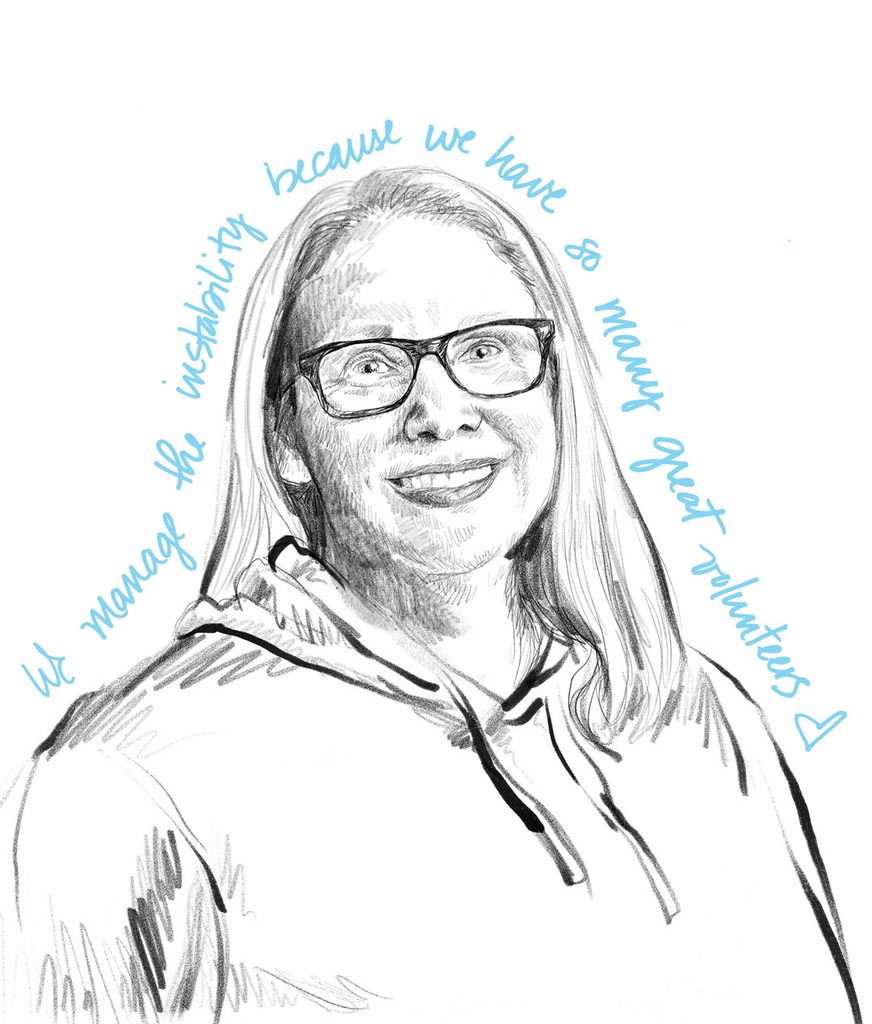
We manage the instability because we have so many great volunteers who are very willing to step up and do anything.
I looked around and saw that nobody else was really doing this, at least not for this specific population. The resettlement agencies are doing a lot, but it ends once everybody has a job, you have a place to live and one person has a driver’s license. But these kids need something to do. All they want to do is play soccer, but their parents can’t afford that. Their parents can’t drive them. I would be able to have an impact that was going to be as great or greater [than] as a teacher.