A weight off her shoulders
How Anne Harris Carter found authenticity by talking about her mental health
As told to Macey Shofroth | Photo by Duane Tinkey | Illustration by Kate Meyer
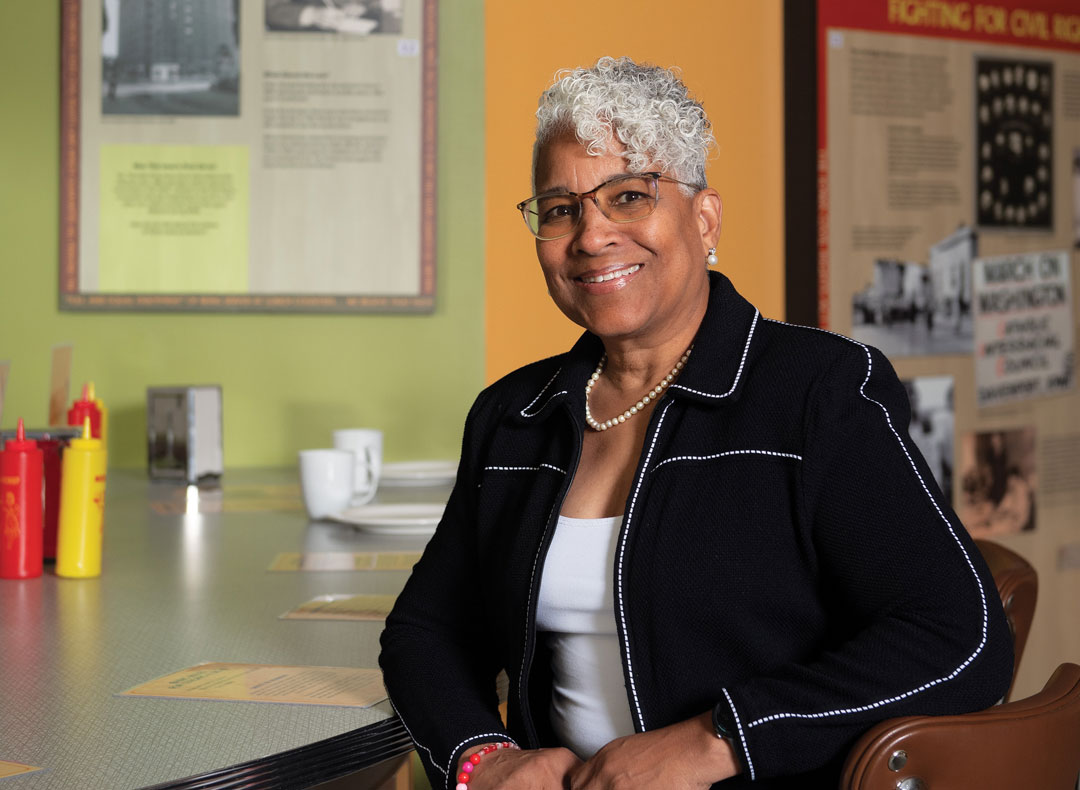
Anne Harris Carter comes from a family with deep roots around Iowa.
Her dad is considered the first Black doctor in Cedar Rapids. In Waterloo, her maternal grandmother was the first Black teacher and her maternal grandfather was the first Black doctor. Her aunt and uncle, Penny and Lee Furgerson, founded Gateway Dance Theatre in Des Moines. She grew up with 11 siblings.
Carter went on to forge her own career in the corporate sector. She spent time in different regions east of the Mississippi River, such as Connecticut, Washington, D.C., and Columbus, Ohio. She came back to Cedar Rapids, where she was born and raised, in 2008, expecting the stay to be temporary.
Almost 20 years later, she’s still there. She recently began work as the executive director of the African American Museum of Iowa.
“I spent much of my life here in Eastern Iowa, and we all have stories to tell and so many of those dots connect,” Carter said.
One of the most influential instances of storytelling in her own life was when she decided to share with colleagues about her mental health diagnosis. In talking about it, she began feeling like she was showing up at work and in her relationships as her most authentic self.
Carter sat down with Fearless to share about the experience and what it taught her about showing up and being honest.
The following story has been formatted to be entirely in her words, and has been edited and condensed for clarity.
The first time that I spoke openly about my bipolar type II diagnosis happened 10 years after I had been diagnosed.
For 10 years, I had hidden the diagnosis, not talked about the treatment, told very few even family members what I was dealing with. Not only did I hide that for 10 years, but it was another 10 years before I even sought medical help, which is pretty typical for mental illnesses. I thought, “Oh, I’m just dealing with PMS and I just need to deal with this because that’s what smart, strong, successful women do.” I figured other people dealt with similar cycles and that’s the way life was.
During that 10 years of hiding it, I was so determined that at some point I was no longer going to need to take medication. I really didn’t accept or own the diagnosis. I went to a women’s conference where a national speaker addressed the group and talked about her own struggles with mental illness. I was really inspired at that point to share out loud, cautiously.
I worked for a company where we had employee resource groups. At that point, I had confided in a couple of co-workers, and one of those co-workers led the women’s employee resource group. We were talking about maybe, as part of a debrief after that conference, it would be an opportunity for me to share, and I did.
That was in 2018, so almost 10 years ago. I’ve been taking medication now for 18 years, and it still is a journey for me. I’ve been pretty open about the diagnosis and the treatment for two reasons. One is I realize I’m not alone. There are many people dealing with mental illness, either themselves or with family members. In what started off as being a very isolating experience, I found that there was community and support, and that meant that I needed to be a little bit vulnerable to take advantage of that.
The other is that in talking about it, I realized it was very liberating for me. It was a kind of healing, if you will. I still take medication, but there’s not the same stress or wasted energy hiding things.
Ginger Zee, the chief meteorologist for ABC News, spoke at that conference. She had written a book called “Natural Disaster: I Cover Them. I Am One.” I was so inspired that someone of her stature would speak openly, having a very high-profile position and figuring out how to balance those things. It sounds a little bit cliche, but it really was a source of encouragement for me.
The conference was annual, and the employee resource group had a practice of debriefing it a month or so later. It was one of those things where I knew it was the right thing to do, and I knew I had the support of those handful of people that I talked to, but it was still a little bit uncertain. I was in a fairly senior role and wasn’t sure what the reaction would be.
For the most part, people came up to me immediately after I spoke or in the days and weeks to follow. They were very affirming. People would say, “Thank you, I needed that” or “I never would have guessed,” which maybe is meant as a compliment.
Prior to speaking out, our company had gone through a sort of culture shift where we were working with all employees to understand how you show up at work and how you show up at home and how those things contribute to your overall effectiveness. I just had this “boo-hoo” moment that was one of those types of experiences of realizing that I wasn’t being myself at work. Sometimes that meant I wasn’t treating people the way I needed to treat people or the way that I would have wanted to be treated, and that wasn’t sustainable. That had happened six months before the employee resource group meeting, where I was really starting to think about, “How do I show up?”
At the time, I was a pastor’s wife, which is another layer of, at least for me, perceiving that I needed to present a certain face to the public and to the congregation. Perhaps much of that was self-imposed. I had really adopted a perfectionist-type mentality. I considered myself reasonably smart, and for whatever reason had reinforced that being smart means you don’t make mistakes, which is not true. And that’s not even a value that we taught our children, but somehow that’s what I had embraced.
I remember some relationships where I didn’t realize I wasn’t being the type of manager that people deserved, or that I thought I should be or was capable of being. At least not consistently. I ended up taking a leave from work for five weeks. I got to a breaking point where I hadn’t felt that bad since I was first diagnosed. We did a medication change that was, for whatever reason, difficult on my body. I was speaking somewhere about mental illness and after I spoke I said, “I need to practice what I preach and take some time for me.”
Bipolar II looks more like depression, and so instead of mania, there’s hypomania. It’s a little bit less erratic, if you will, and then the lows are depressive. However, if someone with bipolar is treated only with antidepressants, then they could spin into mania or hypomania. It’s a different type of treatment altogether. The first time I saw a psychiatrist, he declared that I was going to take medication for the rest of my life. That wasn’t very reassuring to me. It seemed like we were trying different types of medications and doses for a long time. That was very frustrating. I didn’t want to be taking the medication in the first place, and for it not to be fixing things was a great source of frustration.
I’d experience highs and lows where the highs meant I was not sleeping, and then I would crash, and often crash into depression and a hard time getting out of bed and not feeling like I wanted to do anything. I still experience some fluctuations in my sleep, but I have much more self-awareness now. So I know that if I’ve been operating at a high and on little sleep, that more than likely I’m going to need extra sleep and be thoughtful about how I’m interacting with people.
My dad is regarded as the first Black doctor in Cedar Rapids. I now live in the family home with one of my sisters. Before my parents bought the land for that home, there was a petition to try to prevent them from purchasing that land. I grew up knowing that some neighbors were neighborly and others weren’t.
To this day, there are two houses across the street that have long, straight driveways with a cement beam separating the two driveways. When I was growing up, I knew that I could walk on one driveway but not on the other because those folks had signed the petition. I have 11 siblings, and I was probably the most rule-abiding of any of them. Looking out my kitchen window every day now, I realized that’s where I developed a fear of ruining the family name. Every once in a while, it creeps up still, especially being at this museum and being in this public role.
After sharing about my diagnosis, I was able to breathe. It didn’t mean that I started off every meeting talking about my treatment or diagnosis, but it was a weight off of my shoulders. That created other opportunities for me to share. I am on the board of one of the hospitals here, and they were rolling out a campaign around mental illness, so I got involved in that. There was a job that I interviewed for where I even made it a part of my presentation. I just think of that as really liberating. If you’re hiding something, it’s kind of like you hold your breath and get all tense physically as well as emotionally.
I didn’t really talk with my children about what I was experiencing. I imagine that I cried a fair amount. Now that my children are adults, we do talk about it. They know about my medication, and they’ve talked to me about what they’re experiencing and medications that they’ve tried or what their doctor is sharing with them. Now my daughters are both mothers, so just seeing how even their 1 1/2-year-old or 3-year-old make talking about feelings just part of what we do. Back then, I may not have been the best model. But I’m grateful that now we have a much more open dialogue.
Faith is really important to me. So in my faith belief, the idea of trusting God is a priority. It’s a priority in my life. Does that mean that I’m great at it? Not necessarily. But I make it a priority. I’m coming into this position at a time where things that bothered me 10 years ago, I’m not going to lose sleep over. Coming into this job, it’s a big responsibility, but it’s also a big honor. When I think about my parents’ legacy and other family members around the state, it motivates me to bring those stories and help us connect with one another.
Now that I have such a different idea about identity, I don’t want to go back. I value just being able to be yourself. Sometimes, you’re not your best self. I can just say, “I’m kind of tired. I’m just low. It’s not you.” Even saying that out loud makes me able to take a breath and feel that whatever’s next, I can take it on.
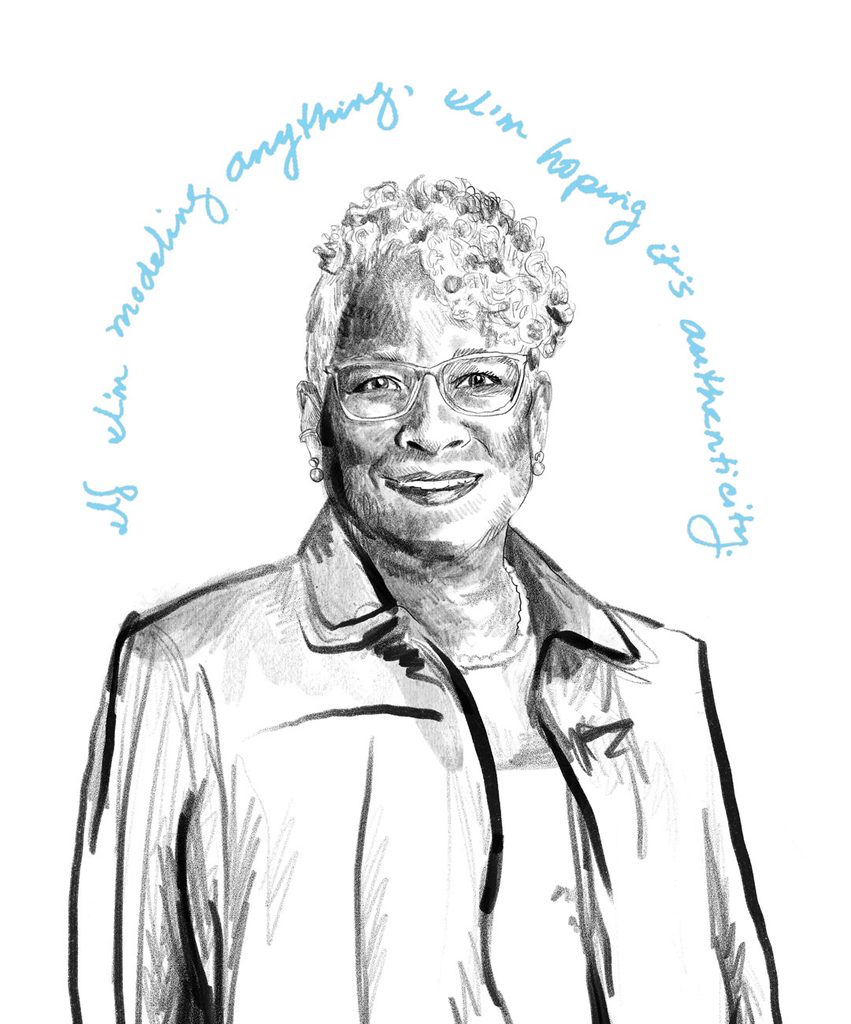
Helping others is reinforcement that I have to be myself. You don’t have to tell your whole story every time you go some place, but there’s always somebody who will benefit from a part of the story. If I’m modeling anything, I’m hoping it’s authenticity.