Women shaping the future of Iowa agriculture

From land ownership and stewardship to technology and agribusiness, women leaders share their perspectives on innovation, change and the opportunities ahead
Growing up on an Iowa farm, following the footsteps of generations of farmers and ranchers in my family, my earliest understanding of agriculture came from watching fields being planted, crops harvested, livestock tended and the land worked.
That image remains an important part of Iowa’s agricultural heritage. But agriculture today is also a complex business ecosystem involving finance, technology, research, land management, supply chains and strategic decisions that affect our economy and communities.
Women have always been part of this story, often working behind the scenes or sharing responsibilities that historically went unrecognized. Today, their influence is increasingly visible, not only in farm operations but also in the boardrooms, businesses and organizations shaping agriculture’s future.
Data back up this shift in ownership and influence. Women own 46% of Iowa farmland, according to a 2025 Iowa State University Extension Report. And according to the U.S. Department of Agriculture’s 2022 Census of Agriculture, more than 50,000 women are agricultural producers in Iowa, representing approximately one-third of all producers. That same report shows that farms with women producers contributed $46 million in agricultural products sold to Iowa’s economy, and states, “Women farmers made key decisions as nearly three-fourths (73%) were involved in financial management, and more than half were involved in estate or succession planning (56%), and land use decisions (52%.)”
These figures challenge some traditional assumptions about who leads agriculture and where decisions about its future are made.
Perhaps even more revealing, a 2023 Iowa State University research report, “Iowa Farmland Ownership and Tenure Survey 1982–2022: A Forty-Year Perspective,” by Jingyi Tong and Wendong Zhang, found that 55% of Iowa farmland is owned by people who do not actively farm. A separate Iowa State University publication, “Survey Increases Understanding of Iowa Women Farmland Owners,” authored by Madeline Schultz, Jamie Benning, Catherine DeLong, Cori Hyde, Melissa O’Rourke, Lisa Scarbrough, Kristine Tidgren, Jingyi Tong and Wendong Zhang, found that 92% of respondents had a role in decisions about their land.
These findings underscore the importance of decisions made beyond day-to-day farm operations, including land use, conservation, investments, leases and succession planning. As agriculture confronts technological advances, economic pressures, changing markets, environmental challenges and generational transitions, these decisions are becoming increasingly consequential. And women are becoming more and more involved in ownership and in decision making regarding the future of agriculture.
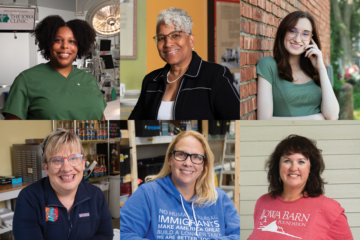
I reached out to four Iowa women who are shaping the future of agriculture in our state. Although their backgrounds differ, each brings a perspective on an industry facing significant opportunities and challenges. From artificial intelligence and emerging technologies to soil health, conservation, diversification and new business models, agriculture’s future will require both innovation and a willingness to reconsider traditional approaches.
I asked these leaders: “Where do you see the greatest opportunities for innovation and change in agriculture over the next several years, and what will it take for leaders to turn those opportunities into reality?”
Julie Kenney, CEO, Agribusiness Association of Iowa
As CEO of the Agribusiness Association of Iowa and a former Iowa deputy secretary of agriculture, Julie Kenney bridges farming, business and public policy. She and her family also operate a corn and soybean farm in Story County. Her experience provides a valuable perspective on the interconnected forces influencing Iowa agriculture.
Agriculture’s greatest opportunities for innovation lie at the intersection of technology, productivity and sustainability. Farmers face complex challenges, from changing weather patterns and pest and disease pressures to labor constraints and demands to produce more with fewer resources. They need solutions that deliver economic and environmental benefits.
Advances in seed genetics, crop protection, fertilizer management and precision agriculture offer tremendous potential to help farmers boost productivity, use resources efficiently and build resilience. Smarter equipment and autonomous systems will expand those possibilities. We’ve only scratched the surface of what innovation can accomplish.
Turning these opportunities into reality requires leaders who invest, collaborate and partner with farmers in Iowa to develop and test solutions in real-world conditions. Equally critical is engaging trusted advisers, especially the talented agronomists at Iowa’s agricultural retailers, who help farmers evaluate new technologies and put them to work. Connecting innovation with trusted, practical expertise is key to accelerating adoption and delivering meaningful economic and environmental benefits.
Sharon Krause, owner, Dalla Terra Ranch
Managing a portfolio of nearly 500 farm acres in Dallas County and through her philanthropic endeavors, which include providing opportunities for smaller farmers, Krause champions innovative agricultural practices and supports conservation research. Her work illustrates how land ownership can be a platform for experimentation, entrepreneurship and lasting community impact.
The greatest opportunities lie in strengthening soil health, improving financial sustainability and expanding market infrastructure beyond a two-crop system. Soil health requires looking beyond nitrogen, phosphorus and potassium to understand the soil microbiome. Healthier soils can support better yields and financial results while reducing inputs needed to manage pests and disease.
Understanding soil conditions can also guide land use, including alternatives to traditional cropping, such as wetlands, native prairie or buffer areas. While we cannot individually control market prices, we can manage our assets and inputs. Conservation agronomists can help through accessible education that evaluates the entire farming system, with profitability as a central goal.
Leaders should invest significantly in making this education widely available to farmers and landowners and expanding market infrastructure to give farmers viable options beyond two crops.
Susan Tronchetti, corporate board director, finance and agricultural enterprises
Co-owner of a Greene County corn and soybean operation, Tronchetti has spent decades working across agriculture, from grain merchandising and seed entrepreneurship to corporate and cooperative governance. Her experience includes serving on the boards and advisory councils of major agricultural and financial organizations, bringing a producer’s perspective to broader business decisions.
Having semi-retired but remaining active in the boardroom, I accepted an opportunity four years ago to help build an Ag Innovation space and team. As someone in my 60s and more than 20 years older than most of the team, I recognized that my value was bringing practical production agriculture experience and boardroom perspective to the conversation.
That effort evolved into designing an Innovation Connector, bringing entrepreneurs and companies together with farmers who would ultimately adopt these technologies.
Across a wide range of innovations, one common theme emerged: Providing more value with less — less labor, [fewer] chemicals, fertilizer, water and other resources while improving safety and efficiency. In today’s agricultural economy, these gains may determine business viability.
Looking ahead, leaders must foster collaboration and ask what’s next in protecting our resources, predicting disease, adapting to weather challenges and improving nutrition. Integrating AI into tomorrow’s solutions and effectively managing the immense volumes of data it generates will also be essential.
Equally important will be proactive leadership in government policy and public education to ensure innovation translates into meaningful progress.
Carole Reichardt, farm manager, Sargent Farms; board director
As farm manager of Sargent Farms and a board director at the Iowa Natural Heritage Foundation, Reichardt brings experience in agricultural management and stewardship, along with a perspective on how landowners can influence farming practices and long-term sustainability.
Across Iowa, a quiet but significant transition is underway as more farmland passes into the hands of women landowners. I believe this transition represents one of the greatest opportunities to reshape the future of Iowa agriculture. Women bring a perspective grounded in family, community, nature and future generations. As caregivers, many understand the connection between healthy soil, clean water, nutritious food and human health. It is a perspective that is urgently needed.
Despite living in one of the most fertile places on Earth, Iowa imports more than 90% of the food Iowans eat, while 1 in 7 Iowans experiences food insecurity. At the same time, 95% of our prized cropland is devoted to a corn and soybean monoculture, with 60% of Iowa’s corn used for ethanol production. Our current industrial approach to agriculture has left many farmers facing economic hardship, rural communities struggling and concerns about water quality and public health intensifying.
There is, however, another path. Farming systems that prioritize soil health, embrace regenerative principles, and reduce reliance on synthetic pesticides and fertilizers can create healthier, more resilient agricultural systems while improving farm profitability. I have seen firsthand a conventional 200-acre corn and soybean farm transform into a thriving organic grain operation. Across North Central Iowa, more than 120,000 organic acres demonstrate that productive, profitable and scalable alternatives already exist. The proof is all around us if we are willing to look.
What is needed now is leadership willing to recognize and support these proven models through farmer education, transition assistance, conservation incentives and policies that reward stewardship. By empowering women landowners and supporting innovative farmers, Iowa has an opportunity to lead the nation in building healthier soil, cleaner water, more profitable farms, stronger rural economies and a healthier future for generations to come.
This is the first in a series highlighting women who are shaping the future of agriculture in Iowa and beyond, and the important contributions they are making to the industry.


0 Comments